

*by Lina Giannakou
Holiday rentals that operate like an online shop. Virtual tours and digital representations of travel experiences. Welcome to the world of ‘phygital’.’
An apartment for short-term let that also serves as an… exhibition space for furniture, decorative items and household goods, all on a platform that attracts millions of visitors every day. The digital world offers countless showrooms for showcasing products, which anyone can purchase from anywhere!
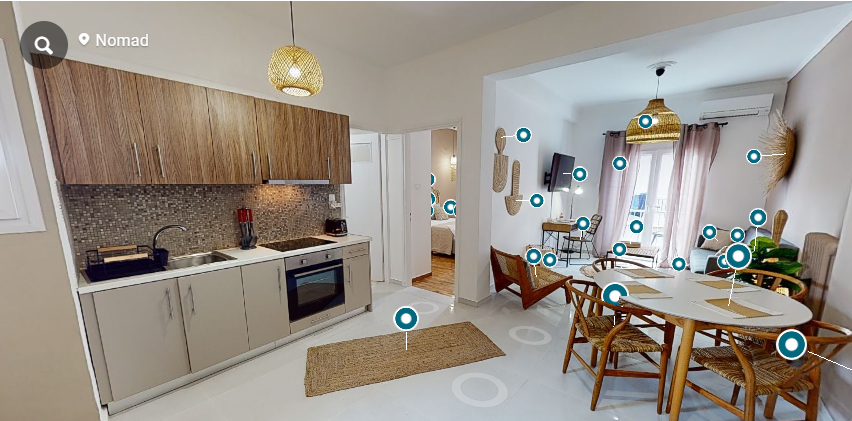
On Loudia Street, a side street running perpendicular to Kifisias Avenue near Ampelokipi, on the 5th floor of a building from a bygone era, lies a flat with a view to the future. In this small flat, available for short-term rental via an online platform, the tenant can enjoy a unique accommodation experience. If they like any of the furniture, tables, mattresses, pillows, clothing or decorations, they can access the digital version of the flat and purchase them with just one or two clicks. Welcome to the first ‘phygital’ (a fusion of physical and digital) Airbnb in Athens.
This is the collaboration between the travel services company CloudKeys and Pennie.gr. ‘The idea came about during the Covid pandemic,’ says Dora Pavlidou, founder of CloudKeys. ‘With everything closed and no income coming in, we were thinking of ways to generate income under the current circumstances and how we would survive if something like this were to happen again.’ Visitors would often ask where they could find a piece of furniture or a decorative item they’d seen in their apartments. ‘I realised they wanted to ask about more things but didn’t want to waste our time or theirs. That’s how we came up with the idea of creating showrooms in real flats where you can live as normal and try out products in real, everyday conditions. Everything fell into place, and an enhanced accommodation experience is now available!’ Today, two such flats are available to rent—or rather, four, as there is also their digital counterpart—where you can take a virtual tour and shop at any time.
Furniture and items viewed by prospective tenants on a short-term letting website are available for sale!
The company’s plans include enabling guests to purchase digital or real-world experiences in the near future. ‘In the same way,’ as Mrs Pavlidou points out, ‘another property could showcase works by local artists.’ The technology already existed—virtual tours are now offered by many hotels in Greece—but CloudKeys found a way to turn it into a profit. It’s not obvious. In the wonderful new world of virtual reality, monetisation remains the biggest challenge.
The staff at Moptil also encountered difficulties in integrating their award-winning DIGIPAST application into hotels; this application, which utilises VR, AR and AI technologies, offers high-quality digital tours of 10 archaeological sites in Greece. ‘Ultimately, we found a way and have already implemented it at the Grand Hyatt and Acropolis Select hotels,’ says Michalis Kokkinos, founder and CEO of Moptil. ‘We provided them with special QR codes which customers can scan to be redirected to the App Store or Play Store to download our app. Through a technology that enables affiliate tracking, we can see from which hotel the purchase was made and thus pay commission. We have even agreed with the hotels to pass the commission on to the reception staff. We want to do the same with Airbnb.”.
I met Michalis Kokkinos whilst he was attending the 9th Our Ocean International Conference, where the issue of climate change was discussed at length, along with how it will affect all aspects of our lives. Including, of course, archaeological sites. “We don’t realise it, but there is no more direct way to preserve a monument than through its 3D representation. It has a direct bearing on its preservation.” A recent UNESCO report and the Acropolis have highlighted the usefulness of new digital tools in developing a management plan to cope with increased visitor numbers. One such tool is COSMOTE CHRONOS, developed by Moptil in collaboration with Cosmote for the Ministry of Culture, through which visitors can admire the monument as it appeared in antiquity. “When you want to raise awareness about monument protection, there is no better way.” The app, which is due to be expanded shortly, has already been downloaded by 350,000 users. “I can’t forget that when it was advertised, 25,000 people spent half an hour virtually exploring the sanctuary of Artemis – which no longer exists – and learning about it.” Parallel worlds, parallel realities, reflecting on one another.
Everything around us is changing. The way we shop, consume, travel and have experiences. Stelios Ioannidis, a researcher at the University of the Aegean, has completed the first doctoral thesis in Greece on how the use of the metaverse will transform the tourism industry. “At the moment, the metaverse is in its infancy. It’s exactly what happened with the advent of the internet in 2000, when only a few very large companies had websites. When you suggested to a business owner that they advertise online, they would reply, ”I have leaflets and my telephone number.“ We all witnessed the change the internet brought about; something similar will happen with the metaverse. It will replace websites. Already, some very large companies such as Nike and Starbucks have created pilot virtual environments for some of their shops. But the major challenge is interoperability – being able to navigate from one metaverse to another.” “The issue with new technologies is their functionality,” says Philippos Arvanitakis, creative director and founding member of the award-winning extended reality (XR) studio South North, based in Gothenburg. “In the 25 years I’ve been in the industry, marketing and technology have been advancing much faster than we can keep up with. We have the ability to do many things, but they have no equivalent in the real world.”
Until now, one could only imagine what an archaeological site looked like in its heyday. Thanks to digital applications, not only can one see it with their own eyes, but they can even explore the monuments!
Recently, South North Studio created a metaverse on behalf of a bank – a fictional city with a main high street where the bank’s branch was located. “They told us it was amazing, but it didn’t suit them because they realised that, in reality, nobody has a VR headset. So we adapted it, and it now works online via the bank’s website.” According to him, the cost-production ratio compared to monetisation potential still shows a loss. “When VR headsets are cheap enough to be in every home, then the situation will change.”
Binazi Science is one of the few organisations in Greece to have purchased VR headsets, or virtual reality glasses. “The reason was to exercise, but I ended up travelling all over the world. I downloaded the interactive app from National Geographic, which allowed me to travel through space and time. I went to Machu Picchu with a camera, and one moment I was amongst the ruins of the Inca houses, and the next I found myself transported back to that era, lying on their woven textiles and gazing at the skulls of their ancestors that adorned their rooms.” With another training programme, she was running in San Francisco alongside the avatars of other athletes. “These are real experiences. They are not fabrications. I feel as though I’ve already been to Peru today. What I’ve learnt about it in this way, I couldn’t have learnt from any documentary. It’s like a dream you don’t remember very well, but which you can revisit whenever you like.”
Stelios Ioannidis, a researcher at the University of the Aegean, has completed the first doctoral thesis in Greece on how the use of the metaverse will transform the tourism industry. According to his research, in the future:
- Tourists will be able to explore destinations digitally before making their final holiday choices, without relying on advertising, reviews or photos.
- They will be able to explore the hotel’s facilities, meet the staff, and inspect the room in detail before making any bookings.
- They can take part digitally in proposed activities at the destination to decide whether they meet their expectations and whether they are worth the time and money they will spend.
- Tourists will be able to significantly reduce waiting times at airports and hotels by using NFTs (non-fungible tokens), as these automatically verify the owners’ details. “So a single NFT can serve as a plane ticket, passport, room key and a means of payment for all of these.”
- Personal data will be protected against any accidental (or even deliberate) leaks of personal information for commercial purposes.
- The experience of taking part in activities will be enhanced through the simultaneous use of augmented reality elements and real-time information for the user.
- Photos and videos of landscapes, moments, people and experiences will be captured, and there will be the possibility of bringing them back into the metaverse. “The avatar enters and relives the memories, rather than simply seeing them.”
“The experience is very intense because the colours are more vivid,” says Science. “You take off the glasses and feel as though the surroundings have faded. I’ve found myself not wanting to go out because I’m wearing the glasses.”