

Dimitris Delevegos
Although sustainability is a key concern for the majority of Greek tourism businesses, only a small minority place the adoption of sustainability criteria at the heart of their strategy.
This is the conclusion of a study carried out by Deloitte Greece in collaboration with the Institute of the Association of Greek Tourism Enterprises (INSETE), which was published yesterday, although its key findings were first presented in June as part of the «Kathimerini» initiative ‘Reimagine Tourism in Greece’. The study was based on primary research carried out between January – April 2023, with more than 200 tourism businesses – members of the Association of Greek Tourism Enterprises (SETE) – taking part.
What does this tell us? That although eight out of ten tourism businesses are already implementing, or intend to adopt immediately, at least one measure relating to environmental and socio-economic sustainability, one in two operators are not involved in strategic partnerships to promote sustainability. 60% of survey participants do not carry out sustainability measurements, mainly because they do not know how. In other words, sustainability and related practices are not yet at the heart of the strategy and operations of Greek tourism businesses, but are treated more as a side initiative.
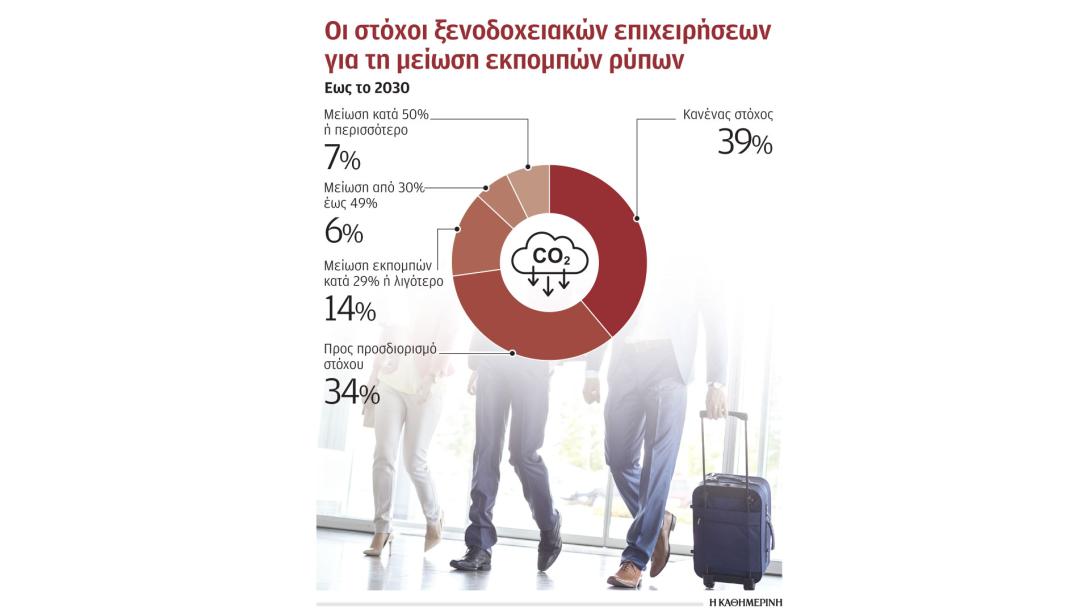
Consequently, 73% of respondents have not set a carbon emissions reduction target for 2030, whilst only 34% are in the process of setting such a target. At the same time, eight out of ten companies have neither adopted nor do they intend to adopt practices, tools and sustainability reporting standards, such as the framework of guiding principles and guidelines for the publication of sustainability reports (Global Reporting Initiative) or the Athens Stock Exchange’s ESG disclosure guide. Nor do they express any intention to do so in the immediate future. Similarly, more than half (55%) of the companies surveyed do not hold any sustainability certification, whilst half are not interested in obtaining one. Furthermore, the overwhelming majority have not integrated sustainability into their governance and organisational structures, whilst only 20% consider that they provide adequate training on sustainability to their staff.
Most tourism businesses do not follow sustainable practices.
According to the survey, tourism businesses with a turnover of less than 10 million euros face significant difficulties in implementing sustainability measures, mainly due to a lack of information and knowledge, but also due to a lack of financial and human resources. However, regardless of size, the main constraint for Greek tourism businesses is the high cost, whilst three in ten are unable to find adequate sustainable solutions. Furthermore, 20% per cent of the businesses surveyed are neither able to demonstrate a return on investment in sustainability nor do they know what kind of sustainable practices and investments they shouldadopt.
According to the survey, businesses are not on the same page as tourists when it comes to adopting sustainability measures. Although international surveys show that nine out of ten travellers seek accommodation where sustainability is a key factor, only 45% of Greek tourism businesses consider sustainability to be a selection criterion.
Source: Daily