


By Giorgos Drakopoulos (*)
It goes without saying that everyone involved in tourism is interested in sustainability. However, it is not a given how theory will be put into practice. This is because, whilst we talk about carrying capacity (CC), we have not yet decided on the indicators we will use, let alone the values they will take.
I would like to remind you of the key indicators for FI (those I favour are in bold):
Tourism Density Index (TDI) = visitors per 100 inhabitants per day,
Tourism Activity Index (TAI) = (beds × 100)/permanent population,
Density of tourist accommodation = beds per km²,
Tourist demand intensity = overnight stays per km² per day.
Firstly, we need to agree on what the variables encompass and then see what is there – and what is missing – in terms of statistical data.
«Beds»: the total number of beds in all types of accommodation (hotels, rooms/flats to let (EU/DD), Airbnb-style accommodation, villas). Officially published and readily available data is only available for hotel beds. With a fair bit of research, we can find the number of beds in private accommodation (rooms and flats for rent), and with even more research, we can estimate the figures for Airbnb. As for villas, we rely on friends and acquaintances.
«Visitors»: we obviously mean tourist arrivals plus day-trippers, whom the Tourism Density Index unfortunately lumps together. However, there is another problem, as we have not clarified what the «residents» variable encompasses; it appears to be the same as the «population» variable in the Tourism Activity Index.
«Population»: is this the figure recorded in the census, or the actual number – that is, the permanent residents of the destination? And where do we place the imported labour force? Among the visitors or within the population? (Let’s not forget that the imported labour force moves around, consumes energy, produces waste, etc., and generates a lot of «overnight stays»).
«Overnight stays»: the total number of overnight stays in all types of accommodation. ELSTAT publishes figures on overnight stays only for hotels and guesthouses. However, no one can vouch for the accuracy of the figures, as they are based on a sample survey in which respondents can answer whatever they like (if they bother to reply at all). As for Airbnb and holiday homes… it’s all down to the platforms.
«Overnight stays» at the destination, therefore, particularly for the purposes of estimating the FI, must also include the overnight stays of permanent residents plus those of the imported workforce. In this case, obviously, they will not be purely «tourist» in nature; otherwise, the «overall pressures» exerted on the destination would be underestimated. However, however, however… we also have day-trippers. Arrivals by cruise ships or day-trippers’ ferries to the islands, and by coaches or cars to mainland destinations. These visitors, whilst they do not stay overnight, do place a strain on the infrastructure and generate waste for as long as they remain at the destination. So, we also need an equivalent number of overnight stays by visitors!
Let me speed this up a bit. In my recent study on Santorini, I needed official statistics for 22 variables directly related to tourism. I could only find data for 9! Using various assumptions and some creative accounting, I estimated a further 9.
So, on this 76 km² island, for the year 2022, we had (figures slightly rounded off):
Beds: 62,000 (Hotels + guesthouses/bed and breakfasts + Airbnb-style accommodation + villas).
Arrivals: 2,187,000 (by air and by ferry).
Passengers disembarked: 1,128,000 (cruise ships + day-trippers).
Total population: 33,000 (permanent residents + migrant workers).
Overnight stays: 19,000,000 (total population + tourists + equivalent of day visitors).
Between May and October, there were between 56,000 and 93,000 people on the island each day.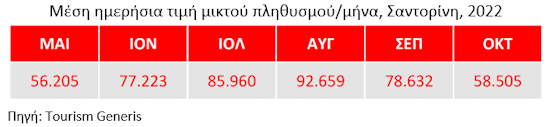
Conclusion: given the significant gaps in the statistical data and the lack of a methodological framework for FI, I do not see sustainability making much of a mark.
(*) Giorgos Drakopoulos is a business consultant, former Managing Director of SETE and President of Affiliate Members United Nations Tourism